
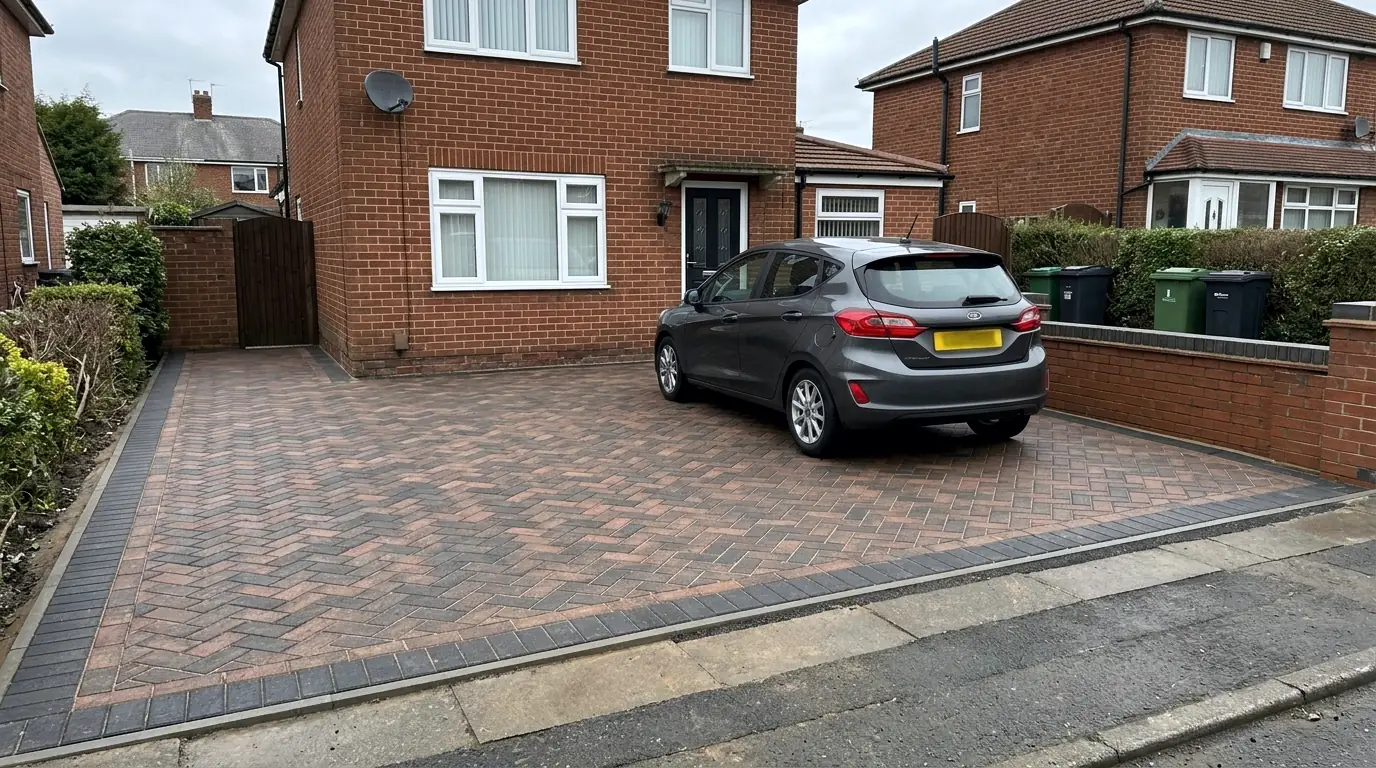
Block paving in Rotherham
Block paving in Rotherham for driveways, paths and parking areas, laid in herringbone or your choice of pattern on a properly compacted base. Block paving is hard-wearing, easy to repair one block at a time, and comes in a wide range of colours to suit the house.
Quick quote
Why block paving
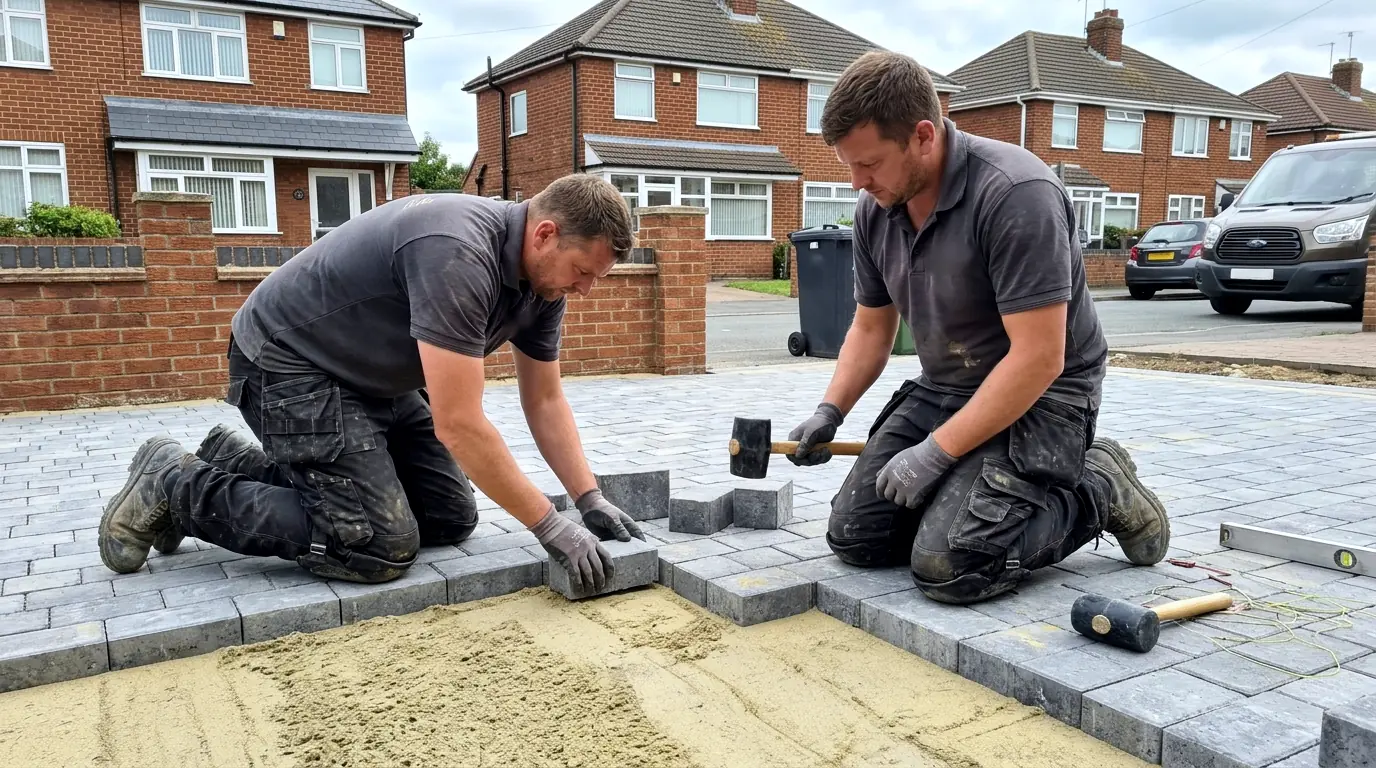
A block paved drive is made of hundreds of small concrete or clay blocks, laid tight together on a bed of sand over a compacted stone sub-base, then locked in place with kiln-dried sand brushed into the joints. Because each block is separate, the drive copes well with the weight of cars and can be lifted and relaid in one spot if a drain or cable needs work.
Herringbone at 45 or 90 degrees is the strongest pattern for driveways, because the blocks interlock in two directions and resist turning tyres. Stretcher bond and basketweave suit paths and patios.
What is included
- Digging out to the right depth and removing the spoil
- A compacted MOT Type 1 sub-base, levelled with a plate compactor
- Edging blocks or kerbs set in concrete to stop the paving spreading
- A screeded sand bed and the blocks laid to your chosen pattern and border
- Cutting in around drains, steps and boundaries
- Kiln-dried sand brushed in and the surface compacted
- A drainage plan: a channel drain, a fall to a border, or permeable blocks
How the job runs
- Survey and quote: size, levels, access and drainage.
- Dig out and sub-base.
- Edging and sand bed.
- Laying, cutting and compacting.
Checkatrade puts a standard block paved driveway at about 3 to 5 days, depending on preparation and complexity.
Block paving, drainage and planning in Rotherham
Ordinary block paving with sanded joints is not classed as permeable. Under national permitted development rules, a non-permeable front drive over 5 square metres needs planning permission unless the rainwater runs to a lawn or border. The usual answers are permeable blocks with wider gravel-filled joints, or laying the drive to fall towards a border or a soakaway. (Source: Planning Portal)
Given Rotherham's recent flooding, with 48 families evacuated in November 2019, a drive that keeps its water on your own land is the sensible choice. (Source: Rotherham Council)
New parking space? Rotherham Council needs the parking area to be at least 2.5 m by 5 m before it will approve a dropped kerb, and it may refuse where there is an established tree in front of the property or less than 1 m of clearance beside a streetlight or telecoms cabinet. (Source: Rotherham Council)
Block paving costs
Checkatrade puts block paved driveways at £90 to £130 per m².
- Single-car drive, about 20 m²: about £2,400
- Two-car drive, about 50 m²: about £5,500
Natural stone setts cost more than concrete blocks. These are typical published prices, not our prices.
Frequently asked questions
How much does block paving cost in Rotherham?
Checkatrade puts block paved driveways at £90 to £130 per m². That is about £2,400 for a 20 m² single-car drive and about £5,500 for a 50 m² double drive.
Does block paving need planning permission?
Standard block paving is not permeable, so a front drive over 5 square metres needs planning permission unless the water drains to a lawn or border. Permeable block paving does not need permission under the national rules for houses.
How long does it take to lay a block paved driveway?
Checkatrade says a standard-sized block paved driveway takes about 3 to 5 days, depending on how much preparation the site needs.
Which block paving pattern is strongest?
Herringbone. The blocks interlock in two directions, so the surface resists the twisting force of car tyres better than straight-line patterns.
Can you repair a section of block paving?
Yes. Individual blocks can be lifted, the base fixed and the same blocks relaid, so a sunken patch or a stained block can be put right without redoing the whole drive.
Why do weeds grow in block paving?
Weeds root in the joints when the sand washes out or collects dirt. Keeping the joints topped up with kiln-dried sand, or using a joint sealer, cuts down on weeds.
Get a block paving quote
Send the size, the pattern you like and your postcode. We will reply by email to arrange a visit.